


UPDATE (5/7/26): Today’s Kings Contrivance Crown Prints newsletter includes the following update on the Village Center:
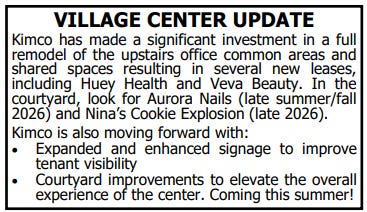
This update directly contradicts my central thesis that Kimco isn’t attempting to lease up Kings Contrivance because they’re positioning it for redevelopment. The newsletter suggests they are investing in the center, bringing in new tenants, and trying to make the retail spaces more appealing. Maybe it really is just difficult to lease interior courtyard spaces — even for a landlord demonstrating success at Hickory Ridge.
The county still very much wants village centers developed into dense, walkable mixed-use, and I still believe Kings Contrivance would be at or near the top of the list if and when the county’s village center redevelopment process is streamlined. But this new information makes me question the conclusions I reached in the article. The article remains as published on Sunday, May 3rd.
Last week, I posted on Facebook about the vacancies at the Kings Contrivance Village Center. The reception was not unexpected. Residents flooded the comments with a familiar mix of grief and frustration. The list of departed businesses was long, and the comments kept adding to it. Multiple residents, independently of each other, pointed to the same explanation: high rents. Some went further, saying they’d heard Kimco was intentionally letting spaces sit vacant, positioning the center for the same residential redevelopment play they successfully completed at Wilde Lake and attempted, but failed, at Hickory Ridge.
The community’s frustration is understandable. Kings Contrivance has Harris Teeter — arguably the best grocery anchor of any Columbia village center — drawing customers to the center every single day. The parking lot is always full, but the interior courtyard is regularly empty. The location is superb: right off Route 32 between US-29 and I-95, with very few competing retail centers in close proximity. Kimco’s own marketing materials tout average household incomes of $201,657 within three miles and education levels 1.9 times the national average.
And yet nearly 20,000 square feet of retail sits empty.
Here's what I think is happening: Kimco isn't leasing Kings Contrivance because they're planning to redevelop it. They're not redeveloping yet because they're waiting for the rules to change. And the rules may be about to change. To understand my thesis, let me walk you through what Kimco’s past actions were at other village centers.
This is the tale of three village centers.
Village Center No. 1: Wilde Lake
When Jim Rouse designed Columbia in the 1960s, the village center was the beating heart of his vision. Each village would have exactly one retail center — the only retail game in town by design — providing everything residents needed. Groceries, banking, dry cleaning, and a place to grab lunch. The village center wasn’t competing with a strip mall down the road. It was the only option, and the community gathered there because there was nowhere else to go.
Wilde Lake Village Center was Columbia’s original, opened in 1967. Giant Food was the anchor. For decades, it worked exactly as Rouse intended. But as more commercial corridors were added throughout Columbia in the 1990s, competition emerged, the village center lost some of its luster, and ultimately, Wilde Lake’s Giant closed in 2006. Kimco Realty, a New York-based real estate giant and the largest owner of open-air shopping centers in North America, owns six of Columbia’s nine village centers. They didn’t build them — they acquired them in 2002 from the Rouse Company — and their core business is retail real estate optimization, not community placemaking.
Kimco eventually concluded the pure retail model wasn’t working nor maximizing their returns and began exploring a mixed-use redevelopment that would add residential apartments to the center. What followed was a lengthy community engagement process — Kimco worked with the Wilde Lake community, incorporated their suggestions, preserved the original buildings that flanked the courtyard and housed many longtime favorite retailers, and designed new structures that took resident feedback to heart. By accepting the apartments, the community gained meaningful say in the retail component. The result was a genuine collaboration. Kimco broke ground on an $18 million redevelopment in 2013 — demolishing the vacant Giant building, adding a separate 230-unit apartment building with ground floor retail, and constructing three new retail buildings that became home to Starbucks, CVS, and David’s Natural Market.
Central to the redevelopment was David’s. David’s wasn’t a replacement tenant — they were an original 1975 fixture who had grown from 1,000 square feet to 12,000 square feet over four decades, absorbing neighboring storefronts one by one. Kimco built a brand new 24,000 square foot building specifically to David’s specs as the first phase of construction. The community supported the redevelopment partly because it preserved David’s.
And then David’s closed anyway in 2023 amid increased competition and changing consumer habits — not due to anything Kimco did. Kimco was able to recruit Grocery Outlet to replace it. Grocery Outlet was a great store, but short-lived, closing in March 2026 as part of a company-wide restructuring that took down 36 locations at once. Nothing to do with Wilde Lake specifically, but it leaves the center with a meaningful void. What comes next for this grocery spot? The options are dwindling. I can think of only one small-format grocer that would work perfectly in this space. I won’t say what I’m thinking because I genuinely don’t want to jinx it. Let’s just call it Raider Woes. Or maybe Gator Pros. Or Later Bros. I have absolutely no idea what I’m referring to. Neither do you. Moving on. (This is purely speculative. Don’t get too excited.)
The grocery asterisk is real but beside the point. Wilde Lake is thriving. The 230 apartments enabled Kimco to recruit national anchors that require new construction and foot traffic guarantees. Starbucks and CVS are here because of the redevelopment. Around those nationals, a mix of independent operators has taken hold in the original section of the village center — Feet First, Bagel Bin, Curry & Kabob, amongst others. Chadol Korean BBQ recently opened and looks fantastic. Even Keel, a Maryland wellness spa, just leased the long-vacant corner space in the Vista apartment building.
Despite the grocery vacancy, Wilde Lake works. Upon its reopening post-redevelopment, Kimco’s own executive called it “the poster child of how you can take something that through no fault of its own is broken, and turn it into a true showpiece.” They meant it as a template. “Wilde Lake really opens the doors for us to potentially be able to change some, if not all, of our village centers.”
Village Center No. 2: Hickory Ridge
I’ve been covering the Hickory Ridge Village Center saga since I started this blog in 2019 — it was literally the topic of the first long article I ever wrote — and I have covered it extensively ever since. I’ll give you the condensed version.
Kimco proposed the Wilde Lake playbook for Hickory Ridge — the same 230 apartments, a new village green, and several new-build retail buildings, while preserving the original structure that houses Giant and a half dozen other retail spaces. This time around, the community was far less collaborative.
A vocal opposition group of residents, claiming they represented the majority view of all village residents, fought hard against Kimco’s proposal and ultimately won. First with the zoning board, then with the courts. Under Columbia’s New Town zoning code, a village center redevelopment of this scale specifies that residential uses must “support and enhance, but not overwhelm” the other uses of the village center. That single phrase became the legal battleground. Kimco argued that 230 apartments would enhance the retail. The resident opposition argued it would overwhelm it. The Zoning Board — effectively our County Council members just wearing a different hat — sided with the resident opposition after lengthy proceedings in 2020 and 2021, with 16 hearings totaling 70 hours of testimony, and denied the redevelopment petition. What followed was a years-long legal fight — Kimco appealed first to the Howard County Circuit Court, lost, and then the Maryland Appellate Court — losing for good on April 24, 2025.
I’ll be direct about where I stood. I was a Hickory Ridge Village Board member during the legal phase of this battle who supported the redevelopment and opposed using our residents’ money on lawyers to continue the fight against Kimco. I support housing growth, now and forever, but I also believed apartments were necessary to make the village center retail viable. Time has proven me wrong. I’ll eat my hat on that one.
What happened after the final court ruling is the most important part of this story. With the residential dream dead — at least for now — Kimco pivoted immediately to retail leasing. New long-term leases. New signage. Landscaping. The fountain, broken for years, has been repaired. Proactive steps to make an inward-facing village center more attractive and visible. The transformation is real. RoCo Kitchen + Coffee is open and excellent. Celia’s Cuban Cuisine brings energy and serious flavor. Ranazul is a beloved neighborhood restaurant — these three are now all holding court on the Avenue, and will soon be joined by Savorists Bakery, targeting a summer opening with handcrafted macarons and NY-style cookies. Long-time holdouts Grille Chick’n Pollo, Koto Sake, and Meadows Frozen Custard remain anchored to the center. Of 21 spaces on Kimco’s current site plan, only three remain vacant. I suspect they will lease up soon.
Independent restaurants — the kind with owners active in their community, who pass the litmus test of actively engaging with their customer base on the Howard County Eats Facebook group — are exactly the type of community-oriented retailers best suited for our village centers.
All this came at a cost. During the years of redevelopment uncertainty, HRVC lost some of its best independent operators — Luna Bella closed in 2016, Hickory Ridge Grill in 2018. May they rest in peace. You cannot mention the Hickory Ridge Village Center on Facebook without receiving at least three heartfelt obituaries written in remembrance. They were casualties of prolonged uncertainty and, as the narrative goes, pushed out by a landlord pursuing a different outcome. The hole Kimco is now filling is partly one they dug.
But here’s what Hickory Ridge is now proving: retail could work without apartments. I didn’t think it could, but it’s happening before our eyes. A landlord motivated to recruit the right tenant profile for an inward-facing courtyard — destination independents, not drive-through nationals — can fill a village center. No residential required. Just locally owned businesses that draw a community to them, exactly as the village center concept was designed to do.
Hickory Ridge proves that when properly motivated, Kimco can indeed lease up a village center.
The question that hangs over Kings Contrivance is what is currently motivating Kimco.
Village Center No. 3: Kings Contrivance
At Kings Contrivance, a clear pattern emerges when you look at who left and who stayed. The national chains are gone. The independents remain.
McDonald’s, CVS, UPS Store, Subway, Bank of America — all gone. Left standing: Trattoria E Pizzeria, Best Hunan, Sushi Nari, King’s Cobbler, Rita’s, and the Corner Stable, a few others. The businesses that rely on neighborhood loyalty have held on, whereas the ones that rely on visibility, drive-by access, and standardized site models have not. National brands simply do not see the value they once did in operating out of Columbia village centers.
That pattern isn’t random. It reflects the broader shift in how retail works in an inward-facing courtyard center. Kimco understands this better than anybody — they own 500 properties of experience. And they are staring at nearly 20,000 square feet of vacant space with no apparent urgency to fill it. What stands out to me is that none of the courtyard vacancies has been filled in years. Once a business leaves, there has been no replacement. The Bagel Bin space has been empty for 15+ years. That tells me something.
So the question becomes: Door No. 1 or Door No. 2?
Door No. 1: Seek to redevelop the center. Add housing. Add new retail buildings that can attract national brands.
Door No. 2: Focus on what they have — faults and all — and find the right tenant mix at the right rental rates to fill the courtyard spaces.
I think they are choosing Door No. 1. Why else aren’t they making the same type of improvements they’ve committed to at Hickory Ridge? Why haven’t we seen them bring on a any new tenant into a courtyard space in years? But if they are choosing Door No. 1, why let the center languish rather than move forward with a redevelopment proposal? I think I have an answer to that, too, if you bear with me for a second.
One more thing that suggests Kimco is paying close attention to Kings Contrivance — just not in the way residents would hope. At the time of my April 23 Facebook post about King’s Contrivance, Kimco’s own site plan listed Space 19 — The Corner Stable, 6,075 square feet — as available for lease, tagged as a “Former Restaurant.” I published the screenshot. I even drove over and verified. The Corner Stable was open, busy, and staff had no knowledge of any plans to close. The rest of that same site plan accurately reflected current reality — recent departures correctly shown as vacant. The Corner Stable has been a tenant for years. A commenter noted the lease situation had been discussed in the Howard County Eats group about a month prior, with word the restaurant may be in lease renewal negotiations. That might explain why Kimco listed the space as available. It is also, if true, a remarkable negotiating tactic to market your tenant’s space on your public corporate website while renegotiating their rent.
Within five days of my Facebook post, Kimco quietly updated their site plan. Space 19 now correctly shows The Corner Stable as a tenant.
I’m not saying my post had anything to do with the update. But, if you’re reading this: Hi, Kimco.
What I Think Is Happening
Kimco doesn’t want another Hickory Ridge. Too much wasted time. Too much wasted money. A decade of litigation, legal fees, and carrying costs on vacant retail — ultimately, for nothing. They didn’t get what they wanted, and it cost them tremendously. Any rational company looks at that experience and concludes: not doing that one again.
Fortunately for them, they may not have to.
Howard County’s approved long-term general plan, HoCo By Design, specifically identifies village centers as areas to be transformed as the county works to add tens of thousands of new housing units over the coming decades. Village centers are not an afterthought in this plan — they are a significant part of it. Walkable, amenity-rich, already served by infrastructure. Exactly where the county wants to add density.
The county isn't just talking about it either. Long Reach Village Center — owned by the county after being designated blighted — is currently in the midst of the zoning approval process, with Planning Board approval already in hand and Zoning Board consideration currently ongoing. That’s right - there is a village center redevelopment actually happening right now, and I'm over here writing 2,500 words about a village center that isn’t being redeveloped, at least, not yet. Welcome to The Merriweather Post!
To implement the general plan goals, County Executive Calvin Ball convened the New Town Task Force in 2025 to comprehensively review the New Town zoning process — the same code that produced 16 hearings, 70 hours of testimony, and 3 court cases at Hickory Ridge — and recommend modifications. The Task Force has spent the past year studying every aspect of New Town zoning and will issue its final report to the County Executive and County Council in June. The draft recommendations, which were put forward for community feedback last month, include a proposal to dramatically simplify the village center redevelopment process — potentially streamlining it toward something approaching by-right development, where a qualifying redevelopment could be approved administratively rather than requiring the full gauntlet of approvals that thwarted Kimco at Hickory Ridge.
But here’s the catch. The Task Force only outputs recommendations. Recommendations require County Council action to be implemented. And that ain’t gonna happen under this council in their lame-duck period between June’s primary election and next December, when a newly elected Council is seated.
So Kimco waits.
If and when the rules change — if the county effectively rolls out the red carpet to make village center redevelopment less painful — Kimco is already positioned waiting to strike. They’ve demonstrated at two separate village centers that they want to add apartments. And why wouldn't they? Multifamily residential generates far more predictable, higher-margin income than retail leasing ever will. The apartments aren't a complement to the business model. They are the business model. The benefit of on-site residents to retailers below is a byproduct. Not Kimco’s end game.
So, if the county opens door #1, Kimco is gonna walk through it. We know they want to redevelop into mixed-use. The only question is which village center they will move to redevelop first.
Wilde Lake — done. Hickory Ridge — moved on. Dorsey’s Search and River Hill — going gangbusters, no intervention needed. That leaves Harper’s Choice and Kings Contrivance. And clearly, based on everything laid out above, I think Kings has gotta be first in line.
So that’s what I think is happening at Kings Contrivance. Kimco isn’t leasing because they’re planning to redevelop. They’re not redeveloping yet because they’re waiting for the rules to change. And in the meantime, Kings Contrivance residents get what they get.
Hi Kimco — do I have it right?
There are apartment buildings and there are apartments buildings. The best apartment buildings prioritize light and air. Their site designs include green space, courtyards or landscape areas on the periphery. They are built to last, using high quality materials. Contemporary versions are energy efficient. In the best cases, they provide residents with pleasant views.
And then there are the apartment buildings being constructed in Howard County. They use the cheapest possible materials. They are indifferently designed inside and out. They occupy the entire lot. Their energy efficiency is doubtful. In most cases they look out over a parking lot. They are modern day equivalents of New York City “old law” tenements, attempts to build as many units as possible and stay within the letter of the building code. Like tenements, they will probably deteriorate rapidly and become a burden on the community.
Changing the village center redevelopment process is the key! CB-29, the current process used, was well-intentioned but has made the whole process much more onerous than it needs to be, making it possible for a small contingent of vocal NIMBYs to hold too much sway. I am hopeful that our new County Council will implement the NT recommendations quickly!